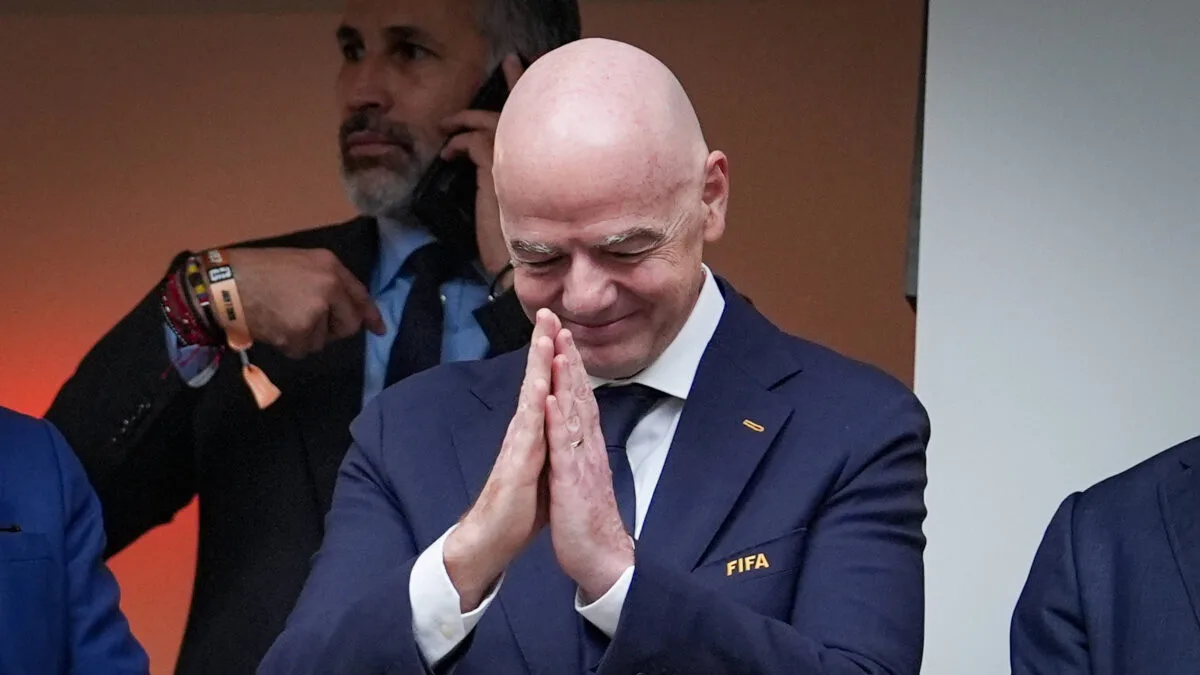
FIFA president Gianni Infantino is facing the most serious challenge of his decade-long tenure after abandoning a controversial plan to sell a minority stake in World Cup and other FIFA tournament revenues to private investors, triggering threats of legal action from UEFA and intensifying scrutiny of his close ties to U.S. President Donald Trump.
World Cup Stake Sale Plan: FIFA Forward Enterprise
The crisis stems from FIFA’s proposal to create a new commercial vehicle, FIFA Forward Enterprise (FFE), that would manage FIFA’s flagship competitions, including the men’s and women’s World Cups and Club World Cups, and then sell about 20–21 percent of that entity to a consortium of private investors for approximately $4.2 billion. The lead investor was Thrive Capital, an investment firm led by Joshua Kushner, whose family ties to Trump’s son‑in‑law Jared Kushner were widely noted by critics.
Infantino pitched the plan to FIFA’s 211 national associations as a form of “democratisation of football,” promising an immediate influx of cash for member federations through a “FIFA Fast‑Forward Programme.” Letters sent to associations outlined one‑off payments of $20 million per federation if they backed the plan, with further tranches—$22 million and $24 million in subsequent cycles—to be distributed between 2027 and 2038, even for associations that opposed the proposal if it went ahead.
Critics, however, argued that the plan amounted to mortgaging part of football’s future to private equity, warning that a heavily financialised FFE could undermine governance, concentrate decision‑making in a small investor group and permanently change the character of FIFA’s competitions.
UEFA Boycott Threat and Legal Notice
European governing body UEFA led the backlash. Within days of the plan becoming public, UEFA’s 55 member federations met and agreed to boycott all FIFA events and competitions while the proposal was active, including future World Cups. The organization said the World Cup and other tournaments were “not FIFA’s to sell” and accused Infantino of trying to “use our sport to enrich themselves and their friends.”
After FIFA withdrew the FFE plan in the face of global opposition, UEFA escalated further by sending a formal legal preservation notice to Infantino and FIFA, instructing them not to destroy any evidence related to the proposal. In a letter from law firm Dechert, UEFA’s counsel Andrew Levander wrote that UEFA was “actively considering legal action, arbitration, and/or regulatory complaints” in connection with the FFE plan and named 18 FIFA executives whose data, documents and electronic communications must be retained as potential evidence.
The letter warns that any “destruction, deletion, alteration, concealment, or loss” of relevant materials after receiving the notice could constitute spoliation of evidence, a serious allegation in potential litigation. UEFA also requested written acknowledgement within five business days, detailing steps taken to preserve records and identifying the person responsible for compliance.
Proposal Withdrawn After “Civil War” in World Football
Facing what Reuters described as “three days of civil war in the football world,” Infantino conceded that the proposal was divisive and announced on Friday that it would not proceed, saying the divisions caused by the plan were “no longer in the interest of the objective set out in the first place.” FIFA’s statement stressed that “nobody is selling football,” but the retreat was seen as a major political defeat for the president.
The plan had been opposed not only by UEFA but also by CONCACAF (North and Central America) and the Asian Football Confederation (AFC), which together represent 137 of FIFA’s 211 members. Both confederations issued statements saying FIFA’s leadership had stopped “putting football first” and calling for a “comprehensive reckoning with this presidency.”
European Leagues and Wales FA Withdraw Support
The backlash extended beyond confederations. The head of the European Leagues association said Infantino’s position now looked “unacceptable,” arguing that the failed FFE plan showed a governance model fundamentally at odds with the interests of domestic leagues. The Football Association of Wales publicly withdrew its support for Infantino’s re‑election bid—scheduled for the 2027–2031 term—stating that the World Cup stake sale plan had eroded trust and that it could no longer back his leadership.
These moves suggest that Infantino may face organized opposition ahead of the next FIFA presidential election, a striking change for a leader who has previously been re‑elected unopposed and portrayed himself as politically untouchable within the FIFA Council.
Infantino’s Reported Outreach to Trump Administration
In parallel with UEFA’s legal threat and confederation revolt, Infantino has also drawn scrutiny for reportedly seeking help from the U.S. administration of President Donald Trump to shore up his position. The New York Post, cited by Al Jazeera and other outlets, reported that Infantino attempted several times to reach Trump by phone after the FFE proposal collapsed, feeling “isolated” amid an avalanche of negative coverage and hoping for public endorsement.
The same reporting says Infantino scheduled private talks with U.S. Secretary of State Marco Rubio, with sources claiming a call was due shortly after 9am ET. However, the U.S. Assistant Secretary of State for Global Public Affairs, Dylan Johnson, posted on X that there were “no plans” for Rubio to speak with Infantino and that “there is no call this morning,” effectively contradicting suggestions of imminent high‑level contact.
These developments follow earlier controversies over Infantino’s relationship with Trump, including a FIFA Peace Prize awarded to the U.S. president at the 2026 World Cup draw in Washington, D.C., which prompted human-rights group FairSquare to file a complaint alleging multiple breaches of FIFA’s political‑neutrality rules. The complaint argued that giving such an award to a sitting political leader and publicly endorsing his agenda undermined FIFA’s obligation to remain neutral.
FIFA Governance, Ethics and the Trump Connection
Taken together, the FFE stake sale, UEFA’s legal notice and Infantino’s reported outreach to Trump have sharpened long‑standing concerns about FIFA governance. Advocacy groups and some national associations argue that FIFA’s structure concentrates too much power in the presidency, allowing Infantino to pursue major commercial restructurings with limited internal checks and then seek political cover when they backfire
BBC Sport’s analysis notes that Infantino’s World Cup sell‑off plan was “the most audacious step” of his presidency, deepening his conflict with UEFA and aligning FIFA’s top commercial project with investors closely linked to Trump. NPR’s coverage underscores that the plan’s collapse marks a “stunning defeat” for Infantino and signals that European nations are willing to use boycotts and legal tools, not just rhetoric, to challenge FIFA’s direction.
Infantino’s earlier decision to award Trump the FIFA Peace Prize and public comments such as “This is what we want from a leader,” combined with Trump’s claim of involvement in decisions like the controversial overturning of U.S. player Folarin Balogun’s World Cup red card, have fuelled perceptions that the FIFA president is too closely aligned with U.S. political interests. Infantino denies political interference and insists disciplinary committees act independently, but critics say the cumulative pattern is troubling.
Infantino’s FIFA Future: Uncertain Path to Re‑Election
Reuters and other outlets now frame Infantino’s future at FIFA as in jeopardy, noting that the rapid collapse of the FFE plan and the scale of backlash have damaged his authority. UEFA has publicly stated that “no option should be off the table” regarding his continued presidency and that it and “other members of the football family” have lost confidence in his leadership after what it called a “shabby, backroom, opaque” deal.
For now, Infantino remains in office, and FIFA emphasizes that decisions on its commercial projects must follow statutes and regulatory frameworks involving Council approval and member votes. But with legal proceedings “reasonably anticipated,” as UEFA’s lawyer put it, and with confederations openly discussing alternative leadership, the battle over “who owns football” has moved from abstract governance debates into concrete power politics.
How that battle plays out—through litigation, ethics investigations, election campaigning or negotiated compromise—will shape not only Infantino’s personal trajectory but also the future of World Cup governance and the balance between public-interest sport and private capital in global football.