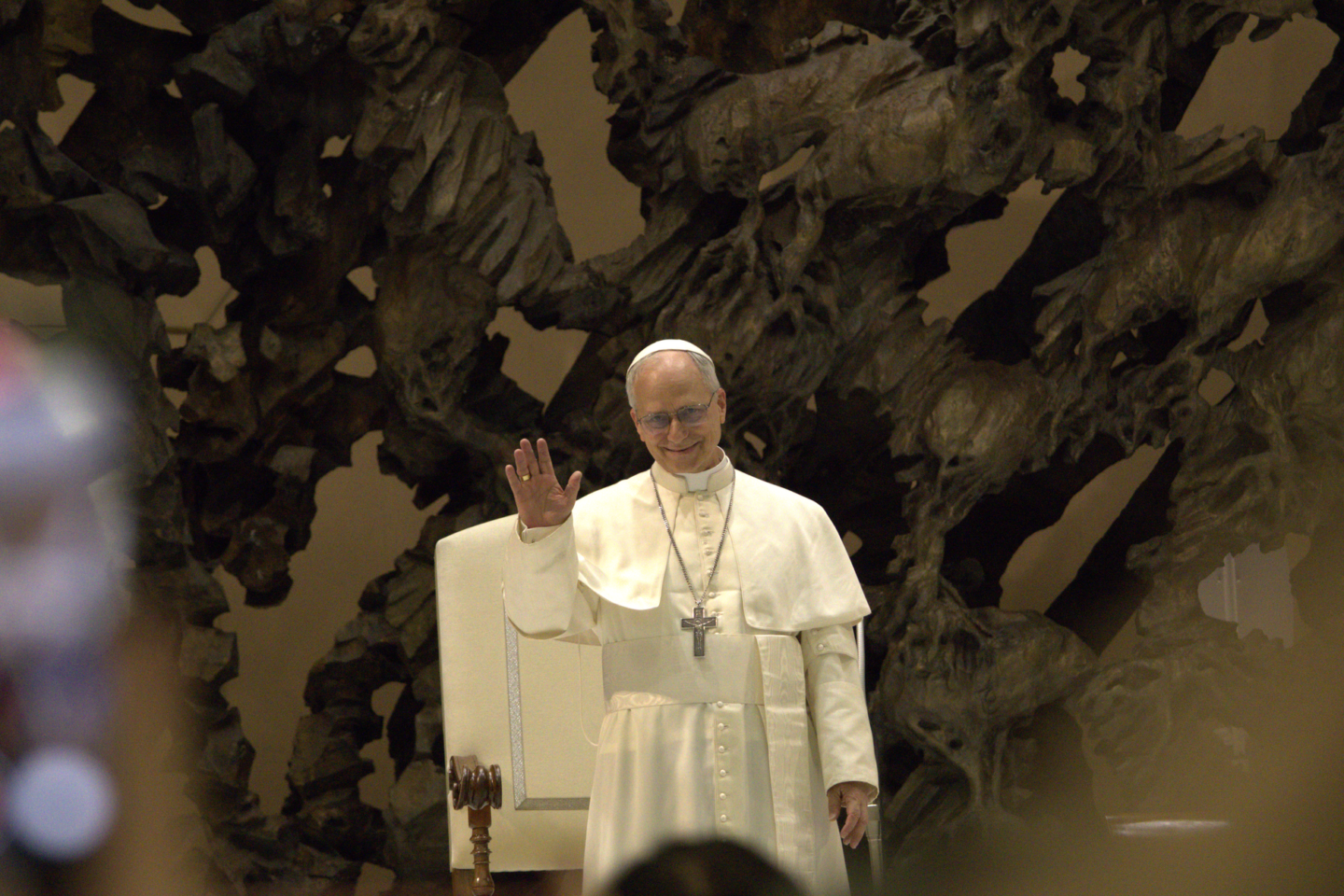
Pope Leo XIV has placed artificial intelligence firmly at the centre of the Catholic Church’s social‑teaching agenda, warning that rapid AI growth could deepen inequality, erode human dignity, and even reshape the future of work and warfare. In his first encyclical, he calls for AI to be “disarmed” from logics of domination and entrusted to strong legal frameworks and public oversight.
“Disarm AI” to Prevent Domination and Exclusion
The 42,000‑word encyclical, titled Magnifica Humanitas (Magnificent Humanity), marks Pope Leo XIV’s most comprehensive intervention into the debate over AI, labour, and ethics. Speaking from the Vatican, the pontiff declared that AI must be “disarmed,” a phrase he used to describe the need to strip the technology of the power structures that risk turning it into a tool for domination, exclusion, and even death, rather than a means of shared human flourishing.
The image is intentionally strong. Pope Leo compared AI to nuclear energy: a powerful force that can either serve the common good or, if left unchecked, lead to new forms of technological and social arms races. He warned that the current race for ever more powerful algorithms and datasets is often driven by geopolitical and commercial supremacy, which can marginalise vast segments of the global population.
The core ethical demand is that AI must remain human‑centred, accountable, and open to public debate, and that ownership of AI data and platforms should not be left in the hands of a small, unregulated elite.
AI, the Future of Work, and the “Culture of Power”
A central theme in the encyclical is the relationship between AI and employment. The pope has repeatedly warned that the pursuit of profit should not come at the cost of widespread job displacement, and his latest teaching reinforces that message.
He argued that a society that uses AI to “slashing jobs” while concentrating wealth in the hands of a few risks creating a “contradiction of material advancement and anthropological decline,” where technological progress widens social fractures rather than healing them. To counter this, the Vatican document urges governments and companies to:
-
Introduce governmental oversight of private AI firms to prevent unaccountable concentration of power.
-
Invest in retraining and social‑safety programs for workers whose jobs are at risk from automation.
-
Ensure that AI‑driven productivity gains are shared more equitably, rather than feeding only shareholder value.
The pope also framed AI as part of a broader “culture of power” that has historically justified exploitation and exclusion, drawing a parallel between the Church’s delayed condemnation of slavery and the current urgency of imposing ethical limits on AI‑driven exclusion. He described AI‑related unemployment and digital‑era inequality as “new forms of slavery” emerging from the digital economy.
Children, Youth, and the “Sense of the Human”
Beyond the economy, the encyclical places special emphasis on the impact of AI on children and young people, a theme the pope has raised in earlier messages. In those communications, he warned that AI could negatively affect the intellectual, neurological, and even spiritual development of new generations who have never lived without instant access to vast information streams.
In Magnifica Humanitas, the pope expands on this idea, arguing that while AI offers unprecedented access to information, it should not be mistaken for true understanding. He stressed that the evaluation of AI’s risks and benefits must be done in light of the “integral development of the human person and society,” including the cultivation of critical thinking, creativity, and moral reasoning.
The encyclical thus calls for:
-
School and family education that equips children and adolescents to think critically about AI‑generated content and avoid over‑reliance on algorithm‑curated information.
-
Regulatory protections that shield young people from violent, hypersexualised, or misleading online content often amplified or manufactured by AI systems.
AI in Warfare and Global Security
The pope’s encyclical also addresses the growing role of AI in military and security contexts, where autonomous systems, targeting algorithms, and cyber‑tools already blur the line between human and machine‑driven decisions.
Pope Leo warned that AI can contribute to the normalisation of warfare and urged that the use of AI in the military, and particularly in autonomous weapons, be governed by the “most rigorous” ethical standards. He stressed that human beings must retain ultimate accountability for life‑and‑death decisions, arguing that systems that are “virtually beyond human control” represent a new kind of moral and practical risk.
The call for “disarming” AI, therefore, is not only about economic power; it is also about cyber and kinetic power—how states and non‑state actors wield AI‑enabled tools in conflict, surveillance, and repression.
Faith, Tech Ethics, and the Role of the Vatican
Pope Leo’s move places the Vatican squarely inside the global AI‑ethics conversation, alongside regulators, tech companies, and civil‑society groups. The encyclical grounds its argument in theological and anthropological claims: that every person carries inviolable dignity; that technology should serve humanity, not the other way around; and that Christ‑like “solidaristic fraternity” must guide how AI resources are developed and shared.
The document also calls for greater collaboration between the Church and AI developers, arguing that dialogue, transparency, and independent oversight are essential if the benefits of AI are to be distributed fairly. Some commentators have noted that the Church is arriving at AI ethics with a self‑critical stance, acknowledging its own historical failures to confront slavery and social injustice, and pledging not to repeat that delay in the digital age.
What the Encyclical Means for Policy and Business
For governments and regulators, the encyclical functions as a moral benchmark rather than a legal code, but it nonetheless pushes for:
-
Stricter legal frameworks on AI oversight, data control, and competition, particularly to prevent monopolistic or oligopolistic control of AI platforms.
-
Regulation of AI‑driven employment changes, including requirements for retraining, social‑protection schemes, and transparency about automation‑related layoffs.
-
Limits on AI‑enabled surveillance and lethal autonomous weapons, aligned with international humanitarian law and the broader “common good” principle.
For businesses, the message is clear: technological innovation cannot be separated from questions of justice, labour, and human dignity. The pope’s call to “disarm” AI is ultimately a call to re‑embed AI governance within democratic, ethical, and social‑welfare frameworks—a challenge that resonates beyond the Catholic world and into the broader debate over the future of the digital economy.