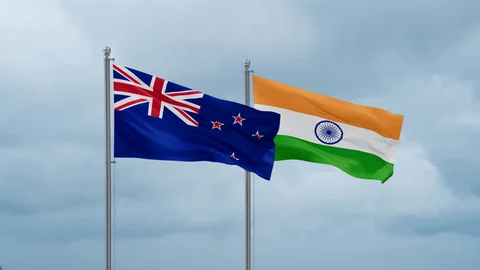
India and New Zealand have concluded negotiations on a comprehensive Free Trade Agreement (FTA), unveiling a deal that both sides describe as historic, ambitious and mutually beneficial. Announced after a phone call between Prime Minister Narendra Modi and New Zealand Prime Minister Christopher Luxon, the agreement grants India zero-duty access on 100% of its goods exports to New Zealand, while sharply cutting or eliminating tariffs on 95% of New Zealand’s exports to India over time. Although the negotiations are complete, the pact will now undergo legal scrubbing and domestic ratification, with formal signing expected in the first half of 2026.
Background: Why India and New Zealand Pushed for an FTA
Bilateral trade between India and New Zealand has remained modest compared with each country’s overall trade profile, but has been growing steadily in recent years. In 2024–25, merchandise trade stood at around 1.3 billion dollars, while total trade in goods and services was estimated at about 2.4 billion dollars, with services alone accounting for roughly 1.24 billion dollars. Both governments saw scope to deepen this relationship by lowering tariffs, easing regulatory barriers and expanding cooperation in areas such as services, mobility and investment.
Formal negotiations were launched in March 2025 during Prime Minister Christopher Luxon’s visit to India and were wrapped up in a notably quick nine months, reflecting strong political will on both sides. For India, the deal fits into a broader strategy of diversifying export markets and reducing dependence on traditional destinations facing rising protectionism, while for New Zealand it opens more predictable access to one of the world’s fastest-growing major economies and its 1.4 billion consumers.
What the India–New Zealand FTA Actually Provides
Unlike some earlier characterisations, the agreement does not simply eliminate tariffs on a uniform percentage of tariff lines; instead, it offers asymmetric but complementary gains. New Delhi has secured zero-duty market access for 100% of Indian goods exports to New Zealand once the FTA comes into force, a key win for Indian manufacturers and labour‑intensive sectors. Wellington, in turn, gains tariff elimination or deep reductions on about 95% of its current exports to India, with more than half of these products becoming duty‑free from day one and the rest phased in over several years.
On India’s side, simple average applied tariffs—currently above 16% on many products—will come down progressively on tariff lines that have been offered, although nearly 30% of lines, largely in sensitive sectors, remain excluded. The pact also extends Most Favoured Nation (MFN) treatment in selected services areas, strengthens disciplines on rules of origin and trade facilitation, and includes detailed provisions on customs cooperation to make border procedures quicker and more predictable.
Crucially, the agreement goes beyond goods. New Zealand has offered market access in 118 services sectors and sub‑sectors and MFN commitments in 139, while India has opened 106 sectors and extended MFN treatment in 45. A dedicated annex on health and traditional medicine—covering areas such as AYUSH and yoga—is a first for New Zealand in any FTA and is intended to support trade in wellness and complementary health services.
Mobility, Investment and Safeguards
Mobility is one of the most visible features of the deal. For the first time, New Zealand has agreed to an annex on student mobility and post‑study work visas with another country, giving Indian students the right to work up to 20 hours per week while studying and access to post‑study work visas of up to three years for STEM and master’s graduates, and up to four years for PhD holders. There is also a new pathway for up to 5,000 Indian professionals in specified skilled occupations to live and work in New Zealand for up to three years, alongside a working‑holiday scheme for 1,000 young Indians annually.
On investment, New Zealand has committed to mobilising 20 billion dollars over 15 years into India under a framework inspired by the European Free Trade Association model, channelling funds into manufacturing, infrastructure, innovation and job‑creating sectors. Both sides emphasise that this is intended to complement, rather than replace, domestic investment, and to help double bilateral trade in the next five years. At the same time, India has ring‑fenced sensitive areas—particularly dairy, sugar and several agricultural and metal products—by excluding them from tariff cuts or placing them in long‑phase‑out or safeguard categories to protect farmers and vulnerable MSMEs.
Who Stands to Gain the Most?
For India, the clearest winners are expected to be labour‑intensive and manufacturing‑oriented sectors that gain duty‑free access to a high‑income market with strong purchasing power. Government briefings and media analyses highlight textiles and apparel, leather and footwear, engineering goods, pharmaceuticals, chemicals, plastics and certain marine products as key beneficiaries of the new access to New Zealand. Indian agricultural exporters are also projected to benefit from improved access for fruits, vegetables, coffee, spices, cereals and processed foods, supported by cooperation initiatives like agricultural productivity partnerships and centres of excellence.
For New Zealand, the largest gains lie in tariff elimination or steep reductions on products such as sheep meat, wool, forestry products, coal and a range of industrial and horticultural exports, with officials estimating an additional 1.1 to 1.3 billion dollars in exports annually over the coming two decades. However, there is far more limited opening for dairy, reflecting India’s long‑standing sensitivity in this sector; New Zealand’s dairy exports will not receive the kind of sweeping access that some in its industry had initially sought.
Services and education are a major opportunity area for both sides. The FTA is expected to strengthen flows in IT and IT‑enabled services, finance, tourism, audio‑visual content, and especially higher education, where New Zealand has been actively courting Indian students. With more predictable visa and work‑rights regimes, stakeholders expect a deeper two‑way exchange of professionals and students in the coming years.
Reactions and What Comes Next
Initial reactions from business groups and officials in both countries have broadly framed the pact as a win‑win, though not without caveats. New Zealand’s government has presented the FTA as a “massive moment” that could deliver thousands of jobs and help meet its long‑term goal of doubling exports, even as some political parties and farmer groups question whether the concessions go far enough or worry about increased competition. On the Indian side, exporters’ associations have welcomed the zero‑duty access and expanded mobility channels, while farm lobbies have taken note of the protections retained for dairy and other sensitive products.
As with any major trade deal, implementation will be crucial. The agreement still needs to be signed and ratified, and officials on both sides will have to translate high‑level commitments into clear schedules, customs procedures and regulatory changes that businesses can actually use. Analysts note that India’s recent experience with the India–Australia Economic Cooperation and Trade Agreement (ECTA) and other FTAs concluded since 2021 should provide useful lessons for rolling out tariff cuts, handling safeguard clauses and monitoring the impact on vulnerable sectors.
If executed effectively, the India–New Zealand FTA could mark a new phase in the economic partnership between the two Indo‑Pacific democracies, tying together trade, services, mobility and investment in a way that reflects their shared ambition to adapt to a more fragmented global trading system. The coming years will reveal whether the promised gains—for exporters, students, professionals and farmers—are fully realised, and whether both governments can maintain the political commitment needed to make this “new‑generation” trade agreement work on the ground.