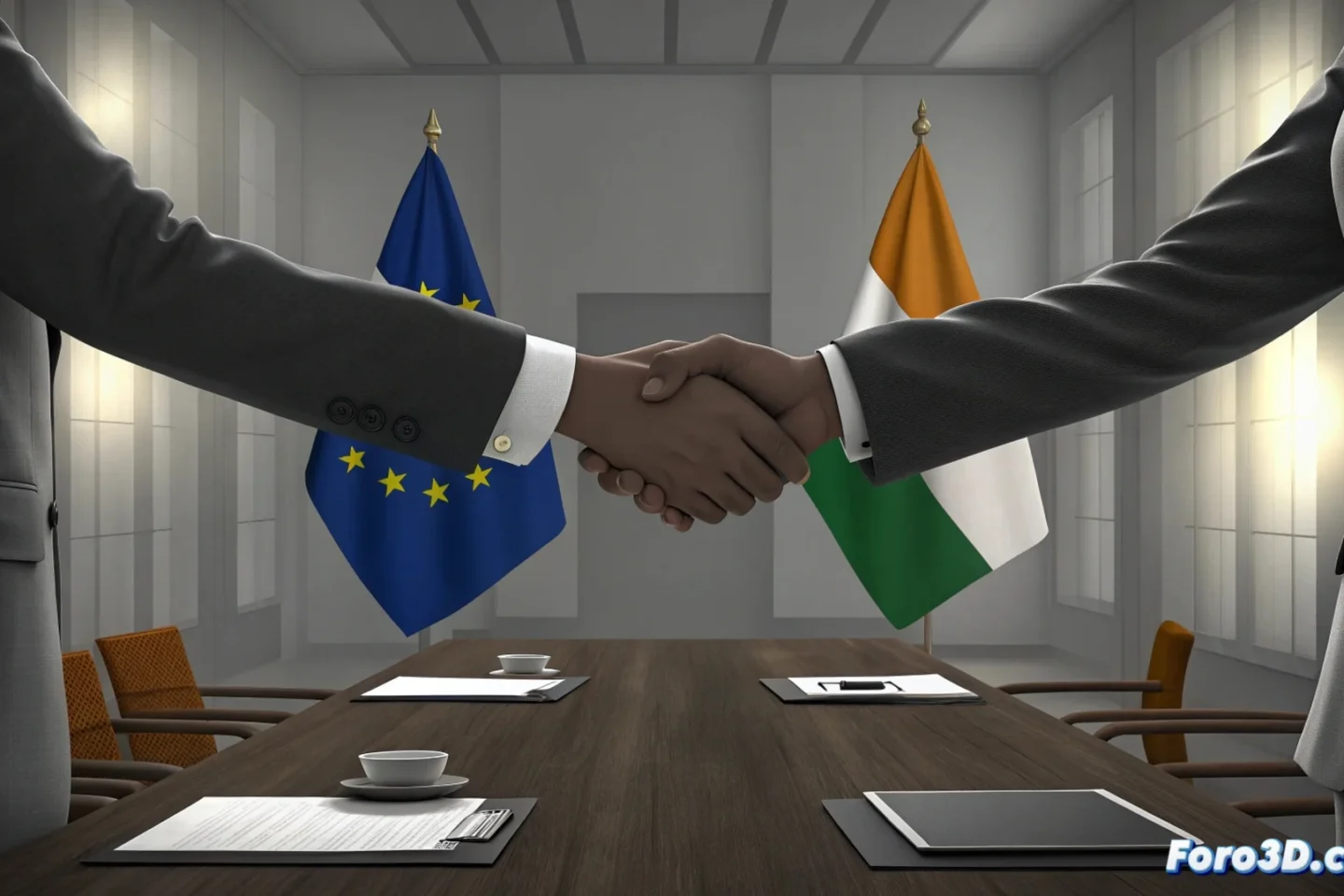
After years of on-and-off negotiations, India and the European Union have now gone beyond “momentum” and actually sealed a historic free trade agreement, transforming what was once a distant prospect into a signed pact that both sides are calling the “mother of all deals.” The agreement, announced at the 16th India–EU Summit in New Delhi, will sharply cut or eliminate tariffs on the bulk of goods traded between the partners and is expected to reshape a trade relationship worth over 130 billion dollars by opening markets on an unprecedented scale.
Talks, which had stalled in 2013 and were relaunched in 2022, accelerated over the past year as both India and the EU sought to diversify supply chains and reduce over‑dependence on other major economies, particularly amid trade frictions with the United States. At the Delhi summit, leaders confirmed that negotiations had concluded and that the FTA text was agreed, with Indian Prime Minister Narendra Modi describing the outcome as a “blueprint for shared prosperity” and European Commission President Ursula von der Leyen hailing it as a win‑win choice for two of the world’s largest economies. While the full legal text will now undergo “legal scrubbing” and ratification, officials say the deal is expected to take effect in 2027, once both sides complete internal approvals.
The agreement arrives in a broader context where the EU is also trying to finalise its long‑delayed pact with Mercosur, the South American bloc of Brazil, Argentina, Uruguay and Paraguay. That deal has repeatedly been held up by environmental concerns—especially deforestation in the Amazon—and domestic political resistance in several EU member states, underlining how climate policy and trade policy are increasingly intertwined. At the same time, the EU is managing tight budgetary conditions shaped by the costs of supporting Ukraine and investing in its own energy security, making growth‑enhancing trade agreements with large partners such as India particularly attractive.
For India, the FTA is part of a rapid push to lock in high‑quality trade deals with developed partners after similar agreements with the UAE, Australia, the UK, EFTA and others in the last few years. New Delhi has framed the EU pact as central to its strategy of boosting manufacturing, services and high‑value exports, while reducing vulnerability to unilateral tariffs from other major economies. Analysts note that concluded deals with Europe and ongoing engagement with other blocs together signal a deliberate effort to anchor India more firmly in reconfigured global supply chains.
Market Access: What Each Side Gains and Protects
At the heart of the India‑EU FTA are sweeping commitments on tariffs and market access that go well beyond previous arrangements. According to official briefings, India will offer preferential or zero‑duty access on 97 percent of EU tariff lines, covering about 97.5 percent of EU exports by value, while the EU will grant preferential access to around 97 percent of tariff lines for Indian imports, covering 99.5 percent of trade value.
On the EU side, tariffs on roughly 96.6 percent of exports to India will be eliminated or reduced, with particularly sharp cuts in sectors such as automobiles, machinery, aircraft and processed foods. India’s duties on imported European cars—previously as high as 110 percent—will be gradually reduced to around 10 percent over several years, under a quota system that caps volumes but still represents a dramatic opening for European manufacturers. Duties on EU wines and spirits, long a major sticking point, will fall sharply too: wine tariffs will decline from 150 percent to ranges near 20–30 percent depending on price brackets, while duties on other alcoholic beverages and processed food products will also be lowered or removed.
On the Indian side, labour‑intensive sectors are clear winners. Immediate duty elimination by the EU will apply to 70.4 percent of tariff lines covering 90.7 percent of India’s exports, including textiles, leather and footwear, tea, coffee, spices, toys, sports goods, gems and jewellery, and key marine products. An additional tranche of tariff lines, covering around 2.9 percent of exports, will see zero‑duty access phased in over three to five years, while a further 6.1 percent will gain improved but not fully duty‑free access through tariff reductions or tariff‑rate quotas on items such as poultry, preserved vegetables, bakery products, cars and certain shrimps. Officials estimate that about 33 billion dollars’ worth of Indian exports currently facing EU tariffs of 4–26 percent will enter at zero duty once the pact becomes operational.
Crucially, both sides have carved out sensitive sectors. India has safeguarded dairy, cereals, poultry, soymeal and some fruits and vegetables from deep liberalisation, reflecting political sensitivities around small farmers and food security. The EU, for its part, has preserved its sanitary and phytosanitary standards and food safety rules, ensuring that high‑profile products like beef and certain agricultural imports remain tightly regulated or excluded.
Markets React, Budgets Watch
Financial markets in India have responded positively to the announcement of the FTA, with equity indices and key export‑linked sectors rallying on expectations of improved earnings and stronger order books. Reports indicate that textile and apparel stocks, in particular, moved higher after confirmation that Indian garments will enjoy zero‑duty access to the EU, giving them a more level playing field against competitors such as Bangladesh and Vietnam who previously benefited from preferential schemes. Broader indices have also been buoyed by the perception that the deal enhances medium‑term growth prospects, even as investors remain attentive to upcoming budget signals from New Delhi.
Within Europe, officials have highlighted that the FTA could save EU businesses around 4 billion euros annually in customs duties once fully implemented, freeing up resources for investment, wages and innovation. The pact arrives at a time when many EU governments are grappling with tight budgets and mounting demands on public spending, making private‑sector‑driven growth via trade even more valuable. However, there is also recognition that adjustment costs will be felt in some European sectors exposed to increased competition from Indian imports, particularly in certain manufacturing and agriculture‑adjacent niches.
Political, Strategic and Human Rights Dimensions
Beyond economics, leaders on both sides have framed the FTA as a strategic signal at a moment of global volatility. Prime Minister Modi has repeatedly stressed that the India‑EU partnership will act as a “double engine of growth” and a source of stability in a global order marked by conflict, supply chain disruptions and rising protectionism. EU leaders, including Ursula von der Leyen and European Council President Antonio Costa, have similarly cast the agreement as proof that major democracies can choose cooperation and rules‑based engagement over fragmentation.
The summit that produced the deal also saw India and the EU sign a separate defence and security pact, committing to deeper cooperation on counter‑terrorism, maritime security in the Indo‑Pacific, cyberspace and joint development of military technologies. Leaders used their meetings to discuss issues such as the war in Ukraine, reform of multilateral institutions including the UN Security Council, and the need for a more effective and representative global governance architecture. This broader context reinforces the sense that the FTA is not just about tariffs, but about positioning both partners within a shifting strategic landscape.
At the same time, some of the debates that marked earlier phases of the negotiations—around human rights, labour standards, environmental protections and digital regulation—are likely to reappear during ratification and implementation. Members of the European Parliament and civil society groups have previously pushed for stronger conditionalities in trade agreements, and similar pressures could shape how certain provisions of the India‑EU deal are interpreted or complemented by side arrangements. Observers also note that domestic political calendars, including future elections in both jurisdictions, may influence how quickly and smoothly remaining legislative steps proceed.
Looking Beyond India-EU: The Mercosur Angle
The EU’s parallel track with Mercosur remains an important part of the broader trade picture. While the India‑EU deal has now been sealed and is moving towards implementation, the EU‑Mercosur agreement is still in limbo, with political resistance in countries such as France and environmental concerns about Amazon deforestation holding up ratification. Some analysts argue that the successful conclusion of the India‑EU FTA could either inject momentum into the Mercosur process—by showing that ambitious deals are still politically possible—or, conversely, reduce the urgency for some member states to take difficult decisions on South America.
From a geopolitical standpoint, securing deep trade ties with both India and Mercosur would significantly strengthen the EU’s hand as it navigates a world marked by intensifying US‑China rivalry, energy realignments and a push to “de‑risk” supply chains. For India, the EU pact reinforces its status as a central player in the Indo‑Pacific and global economic governance, even as it balances ties with the US, Russia and regional partners.
A Turning Point, With Work Still Ahead
The India‑EU FTA marks a turning point after nearly two decades of difficult negotiations, tying together trade, technology, green transitions and strategic cooperation into a single, far‑reaching framework. For Indian exporters—from textiles and leather to marine products, gems and engineering goods—the promise of near‑universal preferential access to Europe’s high‑value market is enormous, while European firms will gain long‑sought entry into a large, fast‑growing economy with a burgeoning middle class.
Yet the hard work is not over. Implementation will require detailed regulatory coordination, capacity‑building for smaller firms, and careful management of adjustment pressures on vulnerable sectors in both economies. As legal teams “scrub” the text and parliaments scrutinise its implications, the success of the deal will ultimately be measured not just by tariff lines, but by whether it delivers on promises of jobs, sustainable growth and a more stable, rules‑based international trading system.