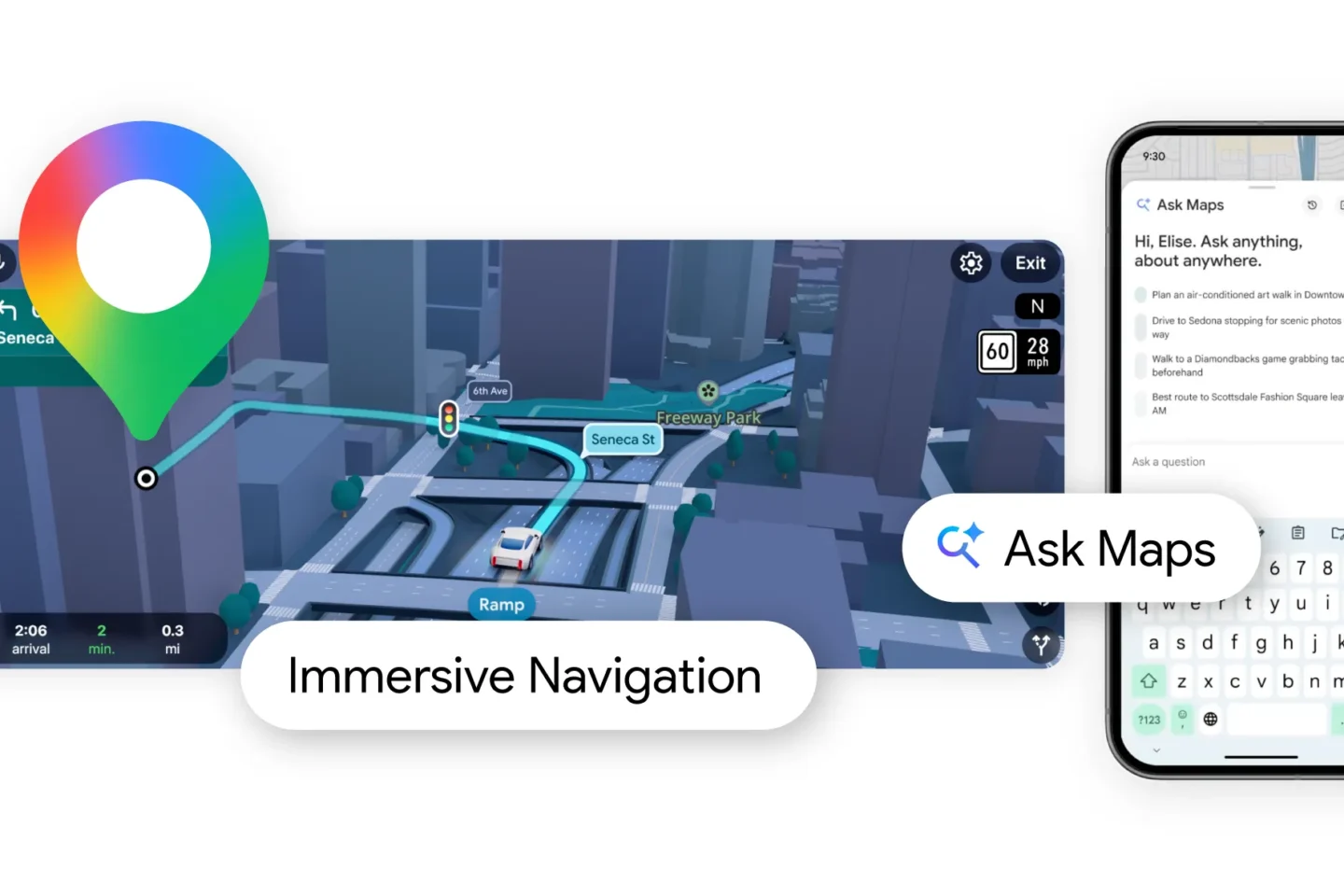
Google is overhauling Google Maps with a pair of Gemini AI–powered features: Ask Maps and Immersive Navigation, in what the company is calling its most significant navigation upgrade in more than ten years. The changes aim to turn Maps from a static routing tool into a conversational assistant and richly detailed 3D driving environment.
Google Maps’ Largest Navigation Upgrade in Over 10 Years
Announced in March 2026, the new experience is built on Google’s multimodal Gemini models, which the company is increasingly weaving through its major products. Google executives describe the update as “fundamentally changing what a map can do,” shifting Maps toward real‑time, AI‑driven assistance rather than simple point‑to‑point directions.
The upgrade centres on two flagship capabilities: Ask Maps, a conversational search layer embedded directly in the Maps app, and Immersive Navigation, a redesigned 3D driving view that makes routes, turns and road context far more visually legible.
Ask Maps: Gemini‑Powered Conversational Search in Google Maps
Ask Maps appears as a new tab or button directly under the Maps search bar; tapping it opens an interface that behaves much like the Gemini chatbot, but grounded in Maps’ real‑world data. Users can type or speak complex, highly specific questions such as “Are there public tennis courts with lights available tonight?” or “My phone is dying—where can I charge it without waiting in a long coffee line?” and receive tailored suggestions plotted on a map.
Behind the scenes, Ask Maps draws on data from more than 300 million places and contributions from around 500 million reviewers, combining details such as opening hours, amenities, busy times, photos and review sentiment. Google says responses are personalised using your Maps search history and saved locations—for example, surfacing vegan restaurants if you typically search for or save vegan spots—while explicitly not pulling data from other apps such as Gmail.
From Pins to Plans: How Ask Maps Changes Local Discovery
Instead of returning a flat list of nearby pins, Ask Maps is designed to assemble context‑rich answers that can span full trip plans. Users can ask it to build multi‑day itineraries—such as a three‑day road trip through U.S. national parks—and receive suggested stops, lookout points and attractions along the way, complete with directions, estimated arrival times and user “insider tips.”
Each Ask Maps answer is packaged with photos, an AI digest of relevant reviews, opening hours and at‑a‑glance cues like price level where available, plus one‑tap actions to save a place or start navigation. Google also allows users to share Ask Maps response threads with friends, turning group planning into a single shareable conversation instead of a series of disconnected links and screenshots.
Immersive Navigation: 3D Maps, See‑Through Buildings and Smarter Guidance
The second pillar of the upgrade, Immersive Navigation, reimagines the in‑drive view with a vivid 3D representation of the route, including buildings, overpasses, terrain and greenery. Rather than the traditional flat overhead map, drivers see a perspective view that highlights critical road details such as lanes, crosswalks, traffic lights, and stop signs to make manoeuvres easier to anticipate.
One hallmark feature is the use of semi‑transparent (“see‑through”) buildings around tricky turns and intersections, allowing drivers to visually “look around the corner” and prepare for the next one or two turns in advance. Immersive Navigation is built by fusing Gemini models with updated Street View and aerial imagery, giving Maps a form of “spatial awareness” of the route rather than just drawing lines on a 2D grid.
Voice guidance is also being overhauled to sound more natural and context‑aware—for example, saying “Go past this exit and take the next one” instead of only quoting distances or exit numbers—while Maps surfaces clearer trade‑offs between alternate routes, such as time savings versus tolls.
Rollout: Where and When Ask Maps and Immersive Navigation Are Available
Google began rolling out Ask Maps and Immersive Navigation in March 2026, starting in the United States and, for Ask Maps, also India, with a phased expansion planned. Ask Maps is initially available on Android and iOS mobile apps in these markets, with a desktop experience to follow later.
Immersive Navigation is first arriving for drivers in the U.S., and will expand over the coming months to eligible Android and iOS devices, as well as Apple CarPlay, Android Auto and vehicles with Google built‑in, according to Google and multiple early reports. The company has not yet published a full global timetable, but positions this as a long‑term evolution of the Maps interface rather than a one‑off experiment.
What the Gemini AI Upgrade Means for Google Maps and Users
For Google, embedding Gemini directly into Maps via Ask Maps is part of a broader strategy to differentiate its AI assistant by tying it closely to real‑world context and products that already reach billions of users. Maps, which marked its 20th anniversary recently and serves more than 2 billion users, is a particularly powerful surface for demonstrating that value.
For users, the upgrade promises fewer taps and more actionable answers: instead of juggling multiple searches and apps to research parking, restrooms, charging points or niche amenities, Ask Maps aims to collapse that workflow into a single conversational query inside the navigation app. On the road, Immersive Navigation’s 3D visuals, clearer lane‑level guidance and more natural voice prompts are intended to reduce missed turns and last‑second lane changes, especially in dense urban environments and complex interchanges.
At the same time, Google’s emphasis on personalisation based primarily on Maps and location activity—rather than email or unrelated personal data—reflects an awareness that users may be wary of AI that feels overly intrusive. As the rollout widens beyond the U.S. and India and more drivers experience these features day‑to‑day, the company’s bet is that Gemini‑powered Ask Maps and Immersive Navigation will become the new default way people explore, plan and navigate in Google Maps.