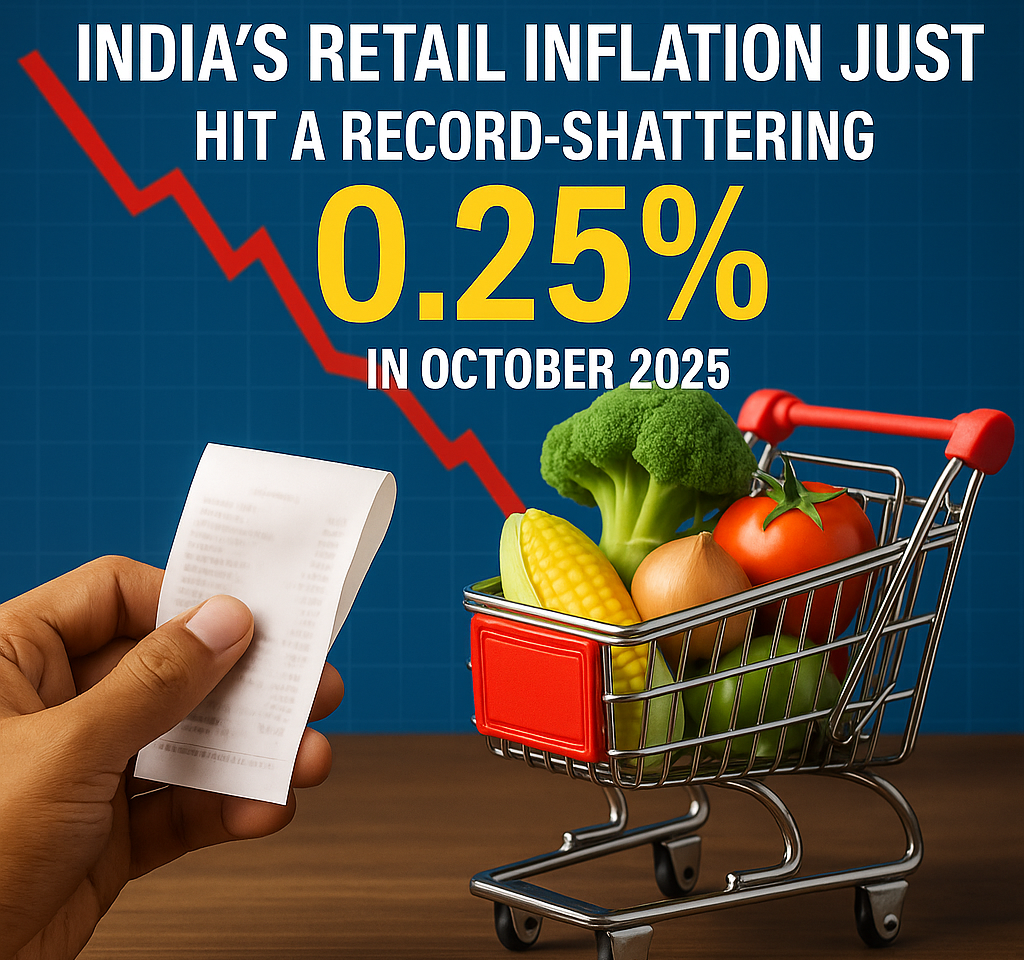
This past October, a number dropped in the economic world that made every analyst sit up straight: India’s retail inflation, measured by the Consumer Price Index (CPI), plummeted to a historic low of just 0.25% year-on-year.
Think of it this way: for every ₹100 you spent on goods and services last year, prices only increased by 25 paisa on average. This is the lowest inflation rate ever recorded in the current CPI series (which uses 2012 as the base year), and it was significantly below the 0.48% that most experts had predicted.
So, what exactly caused prices to fall so dramatically, and what does this mean for your household budget, your bank savings, and the overall economy? Let’s break down this complex economic shockwave in a simple, human way.
The Three Power Drivers Behind the Price Crash
The headline inflation number is a combination of many different categories—from food and fuel to clothes and education. For prices to crash this hard, three major forces had to align perfectly:
The Food Deflation Phenomenon
The single biggest factor pulling the whole index down was the massive drop in food prices. The Consumer Food Price Index (CFPI) plunged into deep negative territory at (-) 5.02% in October.
- What this means: Food items, which make up nearly half of the entire CPI calculation, were actually cheaper than they were a year ago.
- The Cause: This deflationary anchor was primarily driven by a sharp drop in vegetable prices, which fell by an unprecedented 27.57% year-on-year. Favourable weather conditions, strong crop harvests, and ample food reserves helped push prices down across the board.
This -5.02% reading is the sharpest decline on record for food prices in the current CPI series, offering significant, immediate relief to household grocery budgets.
The GST Tax Cuts Kicked In
In late September, the government rationalized the Goods and Services Tax (GST) rates, cutting taxes on hundreds of mass-consumption goods, including several dairy products, cereals, and personal care items.
The Impact: October was the first full month where the effect of these tax cuts was completely realized in the market prices. This fiscal intervention successfully lowered the cost of manufactured goods, visible in categories like Transport and Communication, where inflation moderated sharply to 0.94%. This policy move acts as a direct, powerful push from the supply side, complementing the relief provided by cheap food.
The “Base Effect” Magnification
This is the technical bit, but it’s crucial: The low 0.25% number is amplified by what happened exactly one year prior. In October 2024, inflation was substantially elevated at 6.21%. When you calculate the percentage change from a very high base (last year) to a very low price level (this year), the resulting drop looks enormous—a nearly 600 basis point decline. This statistical effect helped ensure the 0.25% reading was a record-breaking figure.
The Hidden Price Tag: Why Some Costs Remain High
While headline inflation is near zero, not everything is getting cheaper. Economists look closely at Core Inflation—which excludes volatile food and fuel prices—to gauge underlying demand strength and price stability.
In October, the core inflation rate remained sticky at around 4.4%. This is almost double the overall headline number, telling us two important things:
- Investment vs. Consumption: Part of the stickiness was due to extraordinary price increases in precious metals like gold and silver. These are driven by investment decisions, not daily consumer spending, and they skew the core number higher.
- Services Are Costly: Prices for essential, non-tradeable services remain stubbornly high. Categories like Health (3.86%) and Education (3.49%) continue to show inflationary pressure due to fee revisions and structural costs.
Crucially, the inflation number in rural India actually slipped into negative territory (-0.25% CPI Rural). While cheap prices sound great for consumers, sustained negative inflation signals deep distress for farmers and producers, eroding rural incomes and potentially dragging down overall demand.
What Happens Next? Your Interest Rates
The low inflation print gives the central bank (the Reserve Bank of India, or RBI) a clear signal: the immediate threat of price instability has vanished. The RBI is mandated to keep inflation around 4% (plus or minus 2%), and the current rate is far below that range.
- The Expectation: This record-low inflation has created strong consensus among economists that the RBI’s Monetary Policy Committee (MPC) will implement a 25 basis point (bps) interest rate cut in its December review.
- The Goal: Such a rate cut wouldn’t be just a reaction to low prices; it would be a deliberate move to shift policy focus toward supporting economic growth and stimulating demand. Lower interest rates can make loans (like home and car loans) cheaper, encouraging consumer spending and business investment.
In short, the current phase of low inflation is a temporary window, fueled by generous agricultural output and smart tax policy. The RBI must use this window wisely to support growth before the base effect fades and inflation potentially starts creeping up again in the new year.